
Superior Mesenteric Artery Syndrome
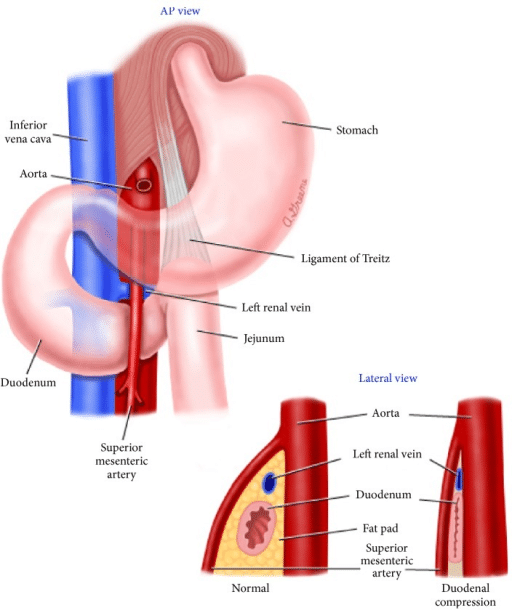
Superior Mesenteric Artery Syndrome (SMAS) is a condition that happens when part of your small intestine, called the duodenum, gets compressed. The duodenum is the first part of the small intestine that starts right after the stomach. It’s shaped like a “C” and is about as long as your hand.
- For Patients
- For Physicians
Background
Superior Mesenteric Artery Syndrome (SMAS) is a condition that happens when part of your small intestine, called the duodenum, gets compressed. The duodenum is the first part of the small intestine that starts right after the stomach. It’s shaped like a “C” and is about as long as your hand.
Normally, the duodenum passes between two big blood vessels called the aorta and the superior mesenteric artery (SMA) without any trouble. But sometimes, these two blood vessels get too close together, making the space too small. When that happens, the duodenum gets pinched or compressed, which can cause problems.1-4
How Common Is It?
SMAS is estimated to affect 0.1% to 0.3% of people. Some people are born with blood vessels in different places or have less fat around their arteries, which can increase the likelihood of having SMAS.5,6
How is SMAS Diagnosed?
Doctors usually start by asking about symptoms and then have imaging done (i.e. CT imaging) to see the structures inside your body. This helps them see if the duodenum is getting pinched.4 Once SMAS has been diagnosed, there are several treatment options that range from conservative management to surgical intervention.
Symptoms1,2
SMAS is more common in younger patients and in females. It is typical for symptoms of SMAS to get worse after eating. Some symptoms include:
- Feelings of nausea
- Feeling full very quickly after eating
- Vomiting
- Pain in the stomach
- Swelling in the stomach
- Losing weight without trying
How Is SMAS Treated?
Doctors first try to help by using conservative treatments, like helping the person gain weight to add fat around the arteries, or having the person lie on their side after eating to help the food pass.4 This may sometimes be difficult since patients with SMAS often have difficulties with eating.
If these methods don’t work, surgery may be needed to fix the problem. There are several different types of surgeries that help the duodenum get more space and relieve the compression.1,2,4,6
Surgical options for SMAS may include, but are not limited to, the following:
- Duodenojejunostomy: involves surgically connecting the duodenum to the beginning of the small intestine. This bypasses the compressed area and may help improve symptoms.
- Gastrojejunostomy: involves surgically connecting the lower portion of the stomach to the beginning of the small intestine. This bypasses the compressed area and may help improve symptoms.
If you want to learn more about SMAS or find doctors who can help, you can visit SAFIRE’s resources page.
What Is SAFIRE Doing?
There is a need for more awareness, better education, and further research about SMAS. SAFIRE aims to restore hope in patients suffering from SMAS by raising funds to support research efforts, to provide resources to patients, and to provide better education for patients and healthcare professionals.
If you want to help SAFIRE with their mission, you can donate on their website.
References
- Ahmed AR, Taylor I. Superior mesenteric artery syndrome. Postgrad Med J. 1997;73(866):776–778.
- Jonas JP, Rössler F, Ghafoor S, et al. Surgical therapy of celiac axis and superior mesenteric artery syndrome. Langenbecks Arch Surg. 2023;408(1):59.
- Lopez PP, Gogna S, Khorasani-Zadeh A. Anatomy, Abdomen and Pelvis: Duodenum. In: StatPearls. Treasure Island (FL): StatPearls Publishing
Copyright © 2025, StatPearls Publishing LLC.; 2025. - Mathenge N, Osiro S, Rodriguez, II, Salib C, Tubbs RS, Loukas M. Superior mesenteric artery syndrome and its associated gastrointestinal implications. Clin Anat. 2014;27(8):1244–1252.
- Salem A, Al Ozaibi L, Nassif SMM, Osman R, Al Abed NM, Badri FM. Superior mesenteric artery syndrome: A diagnosis to be kept in mind (Case report and literature review). Int J Surg Case Rep. 2017;34:84–86.
- Lu SB, Guo YQ, Chen RY, Zhang YF. Laparoscopic Surgery for Superior Mesenteric Artery Syndrome. J Invest Surg. 2024;37(1):2387524.
- Pillay Y. Superior Mesenteric Artery Syndrome: A Case Report of Two Surgical Options, Duodenal Derotation and Duodenojejunostomy. Case Rep Vasc Med. 2016;2016:8301025. doi: 10.1155/2016/8301025. Epub 2016 Dec 22. PMID: 28101395; PMCID: PMC5215251.
Background
Superior mesenteric artery syndrome (SMAS), also known as Wilkie’s syndrome, is a disorder characterized by external compression of the third portion of the duodenum between the aorta and the superior mesenteric artery (SMA).1,2 The duodenum, approximately 25 to 30 cm in length and C-shaped, normally courses anterior to the aorta and posterior to the SMA.3 A reduction in the aortomesenteric angle—often below 25 degrees—results in duodenal compression and subsequent partial or complete obstruction.4
The incidence of SMAS is estimated to be between 0.1% and 0.3%5 Predisposing factors include anatomical variations such as a lower origin of the SMA or an abnormally high ligament of Treitz.2 Additionally, diminished retroperitoneal fat can reduce the aortomesenteric distance, further exacerbating duodenal compression. A study from 2024 found that patients with SMAS may have reduced amounts of adipose tissue between the aorta and SMA, which also leads to a reduction in the angle and a greater compression of the duodenum.6 While many patient have been told to gain weight, the nausea and vomiting associated with SMAS may prohibit this and sadly many patients still experience shaming by health care provider instructing them to simply gain weight when they cannot tolerate oral intake.
Diagnosis
Clinical suspicion arises with characteristic symptoms, especially postprandial pain and early satiety. It has been reported that CT is typically the best imaging technique to confirm the presence of SMAS4, allowing precise measurement of the aortomesenteric angle and distance, and visualization of duodenal dilation proximal to the compression. Once SMAS has been diagnosed, there are several treatment options that range from conservative management to surgical intervention.
Clinical Presentation
Patients with SMAS are usually young and female. The symptoms of SMAS can vary in each patient in both type and severity. Regardless of the type of symptoms a patient may have, it is common for symptoms of SMAS to worsen after eating. Symptoms of SMAS may include any of the following:1,2
- Nausea
- Rapid onset of a feeling of fullness after eating
- Vomiting
- Abdominal pain
- Abdominal distension
- Pain after eating
- Unintentional weight loss
Management
Initial management is conservative, focusing on nutritional support aimed at restoring retroperitoneal fat and thereby increasing the aortomesenteric angle. Positional therapy—such as prone positioning or lying on the left side postprandially—may alleviate symptoms.4 Many patient require a gastrojejunostomy tube for feeding beyond the compression point. Failure of conservative measures may necessitate surgical intervention. Surgical options include duodenojejunostomy, gastrojejunostomy, or division of the ligament of Treitz (Strong’s procedure).1,2,4,6
Clinicians seeking expert consultation or management guidance can refer to SAFIRE’s resources page for a directory of experienced providers and treatment centers.
SAFIRE’s Role
Given the rarity and diagnostic challenges of SMAS, there remains a significant need for enhanced awareness, improved educational outreach, and focused research efforts. SAFIRE is dedicated to supporting these initiatives by funding research, expanding patient resources, and educating both patients and healthcare providers.
If you are interested in supporting SAFIRE’s mission, you are encouraged to make a contribution through our donation page.
References
- Ahmed AR, Taylor I. Superior mesenteric artery syndrome. Postgrad Med J. 1997;73(866):776–778.
- Jonas JP, Rössler F, Ghafoor S, et al. Surgical therapy of celiac axis and superior mesenteric artery syndrome. Langenbecks Arch Surg. 2023;408(1):59.
- Lopez PP, Gogna S, Khorasani-Zadeh A. Anatomy, Abdomen and Pelvis: Duodenum. In: StatPearls. Treasure Island (FL): StatPearls Publishing
Copyright © 2025, StatPearls Publishing LLC.; 2025. - Mathenge N, Osiro S, Rodriguez, II, Salib C, Tubbs RS, Loukas M. Superior mesenteric artery syndrome and its associated gastrointestinal implications. Clin Anat. 2014;27(8):1244–1252.
- Salem A, Al Ozaibi L, Nassif SMM, Osman R, Al Abed NM, Badri FM. Superior mesenteric artery syndrome: A diagnosis to be kept in mind (Case report and literature review). Int J Surg Case Rep. 2017;34:84–86.
- Lu SB, Guo YQ, Chen RY, Zhang YF. Laparoscopic Surgery for Superior Mesenteric Artery Syndrome. J Invest Surg. 2024;37(1):2387524.